
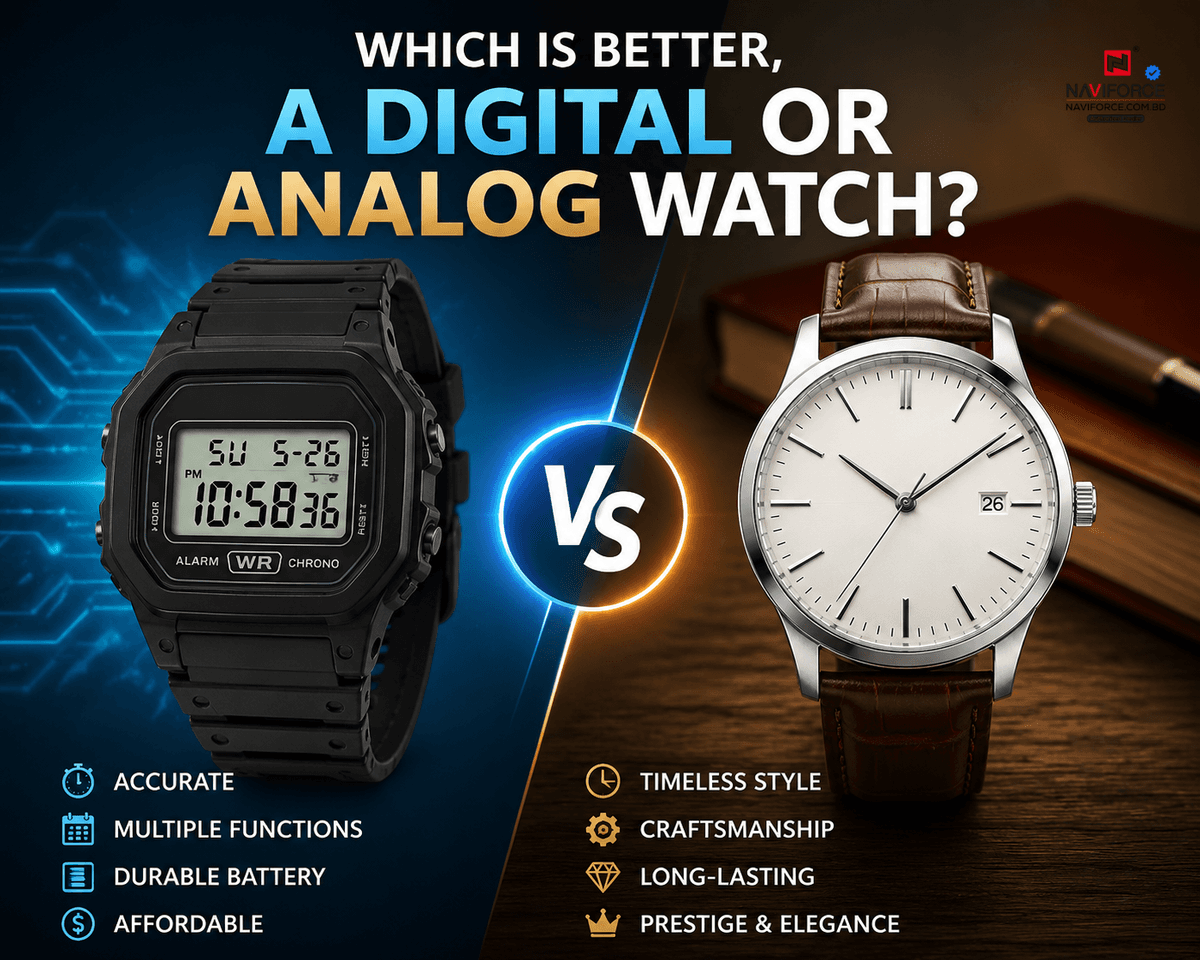
Which Is Better, a Digital or Analog Watch?
Which is better, a digital or analog watch? Neither is universally better. An analog watch is usually the stronger choice for classic style, office wear, formal outfits, and simple everyday timekeeping. A digital watch is often better when you value instant readability, alarms, timers, backlights, sports functions, or a more casual look.
The right choice depends less on which technology is “better” and more on where you will wear the watch, which functions you actually use, how much maintenance you want, and what style suits you.
If you cannot decide, an analog-digital watch can combine traditional hands with a digital display and give you some advantages of both.
Here is the quick comparison.
Digital vs Analog Watch at a Glance
Feature | Analog Watch | Digital Watch |
|---|---|---|
Time display | Hands and hour markers | Numbers on a screen |
Time reading | Traditional | Very quick |
Formal style | Excellent | Usually less formal |
Casual/sports use | Depends on model | Excellent |
Extra functions | Usually fewer | Often more |
Night visibility | Depends on lume/backlight | Usually easier with backlight |
Battery use | Often very efficient | Depends on functions |
Traditional appearance | Excellent | Limited |
Stopwatch/alarm | Less common | Common |
Ease of use | Simple | Can have more controls |
Best for | Office, formal, everyday style | Sports, travel, practical use |
The key is to compare the watch as a complete product, not just the way it displays time.
What Is an Analog Watch?
An analog watch shows time using moving hands positioned around a dial.
A standard design normally includes:
- Hour hand
- Minute hand
- Second hand
- Hour markers
Some analog watches add:
- Date windows
- Day displays
- Chronograph sub-dials
- 24-hour indicators
- Multiple time zones
The mechanism behind the display can vary. An analog watch may use quartz, mechanical, or automatic movement.
So analog describes the display, not necessarily the movement inside the watch.
That distinction is important.
An analog quartz watch and an automatic analog watch may look similar from the front while operating very differently internally.
What Is a Digital Watch?
A digital watch displays time using numbers rather than traditional hands.
For example:
10:42
instead of interpreting the position of hour and minute hands.
Digital watches commonly use an electronic quartz system and may include functions such as:
- Alarm
- Stopwatch
- Countdown timer
- Calendar
- Backlight
- Dual time
- Lap timing
- Hourly signal
The exact functions depend on the model.
A simple digital watch may only show time and date, while a feature-heavy model can act as a practical tool for sports, travel, work, or outdoor activities.
1. Which Watch Is Easier to Read?
For pure speed, digital usually wins.
You look at the screen and see an exact numerical time immediately.
If the display says:
07:48
there is very little interpretation required.
This can be useful when:
- Exercising
- Working under time pressure
- Travelling
- Timing an activity
- Checking time quickly in low light
Analog watches require you to interpret hand positions.
For most people this takes almost no effort, but digital is still more direct when exact minutes and seconds matter.
Digital Is Better for:
- Fast numerical reading
- Timed activities
- Sports
- Work where exact time matters
Analog Is Better for:
- Traditional visual timekeeping
- Quickly understanding approximate time remaining
- People who prefer a conventional dial
Interestingly, an analog dial can make the passage of time easier to visualise.
If a meeting ends at 4:00 and the minute hand is already near the 9 position, you can visually understand how little of the hour remains without doing much calculation.
So even readability is not completely one-sided.
2. Which Looks Better: Analog or Digital?
This depends heavily on personal style, but analog watches generally have the advantage in traditional and formal settings.
An analog dial works naturally with:
- Business shirts
- Suits
- Formal events
- Weddings
- Smart-casual clothing
- Traditional outfits
The dial, hands, case and strap also become part of the overall design.
A simple analog watch can look elegant without needing many additional features.
Digital watches usually create a more:
- Casual
- Sporty
- Technical
- Retro
- Functional
appearance.
That can look excellent with:
- T-shirts
- Sportswear
- Hoodies
- Casual shirts
- Outdoor clothing
The important lesson is:
Do not ask which display looks better universally. Ask which one looks better with the clothing and environment where you will actually wear it.
3. Which Is Better for Office Wear?
For most conventional offices, analog is the safer choice.
A clean analog watch with:
- Leather strap
- Stainless-steel bracelet
- Neutral dial
- Moderate case size
usually blends easily with business clothing.
It looks like an accessory rather than a piece of sports equipment.
Digital watches can still work in casual offices, especially when the design is understated. However, a large sports-style digital watch may look less natural with formal business attire.
Best Choice for Traditional Office Wear:
Analog
Best Choice for Casual or Technical Workplaces:
Either can work
Your workplace dress code matters more than the display technology itself.
4. Which Is Better for Sports and Outdoor Use?
Digital watches often have an advantage here because useful activity functions are easier to integrate into a digital interface.
Depending on the model, you may get:
- Stopwatch
- Timer
- Alarm
- Backlight
- Lap timing
- Dual time
- Calendar
That makes digital particularly useful for:
- Running
- Gym sessions
- Cycling
- Hiking
- Travel
- Outdoor work
However, do not assume digital automatically means durable.
Durability depends on the actual watch.
Check:
- Case material
- Glass or crystal
- Strap
- Water-resistance specification
- Button construction
- Build quality
A poorly built digital watch is not automatically tougher than a well-built analog watch.
5. Which Has More Features?
Usually, digital watches provide more functions for the money.
This is because information such as alarms, timers, dates, and secondary time zones can be displayed electronically without adding multiple physical hands and mechanical displays.
For example, a modest digital watch may offer:
- Time
- Seconds
- Date
- Day
- Alarm
- Stopwatch
- Backlight
A simple analog watch may provide only:
- Hours
- Minutes
- Seconds
- Date
But more features are not automatically better.
If you only need a watch to tell time and match your clothing, extra menus and buttons may provide no real benefit.
The correct question is:
Which functions will I actually use?
6. Which Is Better at Night?
A digital watch with a proper backlight is usually easier to read in complete darkness.
Press the light button and the display becomes visible.
Analog watches can still perform well at night if their hands and markers contain luminous material.
However, the brightness and duration of lume vary by model.
So:
For predictable push-button night visibility:
Digital often wins.
For quick nighttime reading without pressing a button:
A good luminous analog dial can work very well.
Again, check the actual watch specification rather than assuming all products behave the same.
7. Analog vs Digital Battery Life
There is no universal winner.
A simple quartz analog watch can often operate for a long period because moving three small hands requires relatively little power.
A basic digital watch can also have excellent battery life.
However, digital functions such as:
- Frequent backlight use
- Alarms
- Sensors
- Advanced displays
can increase energy consumption.
The real comparison should therefore be between specific models, not analog technology versus digital technology in general.
8. Which Requires Less Maintenance?
For ordinary quartz models, both can be relatively easy to maintain.
A basic analog quartz watch may mainly require:
- Periodic battery replacement
- Strap care
- Cleaning
A basic digital watch may similarly require:
- Battery replacement
- Strap cleaning
- Button and seal care
Mechanical or automatic analog watches are a different category.
Because they use a mechanical movement rather than a conventional battery-powered quartz system, servicing requirements can be more involved over the long term.
Therefore:
Simple quartz analog vs simple digital → both can be low maintenance.
Mechanical analog vs basic digital → digital is usually simpler to own.
9. Which Is Better for Students?
Digital watches often make excellent student watches because they can offer:
- Clear time display
- Alarm
- Stopwatch
- Affordable designs
- Casual styling
However, analog can be better for students who want one watch that transitions easily from:
class → presentation → internship → formal event.
So the decision depends on lifestyle.
Sports-focused student:
Digital
Formal or style-focused student:
Analog
Wants both functions and traditional styling:
Analog-digital
10. Which Is Better for Men?
Neither display is inherently more suitable for men.
The better choice depends on:
- Wrist size
- Clothing
- Work
- Daily activities
- Desired features
- Personal taste
For men who wear formal clothing frequently, analog tends to be easier to style.
For men who exercise, travel, work outdoors, or frequently use timers and alarms, digital may provide more practical value.
A third option deserves attention here.
What Is an Analog-Digital Watch?
An analog-digital watch combines traditional hands with a digital screen in the same watch.
That means you can get:
Analog display for style
plus
Digital display for additional functions.
Depending on the model, those functions may include:
- Alarm
- Date
- Stopwatch
- Week display
- Backlight
- Secondary time
This format is useful for someone who likes the appearance of an analog watch but does not want to give up digital functionality.
It does create a busier dial, though.
If you prefer minimalist watches, a pure analog design may still look cleaner.
Naviforce Bangladesh currently carries dual-display models that combine quartz analog hands with digital information, demonstrating how this hybrid category sits between traditional analog and fully digital watches.
Analog vs Digital vs Analog-Digital
Type | Strongest Advantage | Main Limitation |
Analog | Classic appearance | Usually fewer functions |
Digital | Practical functions | Less traditional styling |
Analog-Digital | Combines style and features | Dial can look busier |
If you cannot decide between analog and digital, the hybrid option is worth considering rather than forcing yourself into one category.
Which Is Better for Daily Wear?
For daily wear, the winner depends on your normal routine.
Choose Analog If Your Day Looks Like:
- Office
- Meetings
- University
- Formal events
- Smart-casual outfits
- Social occasions
Choose Digital If Your Day Looks Like:
- Gym
- Sports
- Outdoor work
- Travel
- Frequent timed activities
- Casual clothing
Choose Analog-Digital If You Frequently Do Both
For example, someone who works during the day but also wants alarms or a stopwatch can benefit from the hybrid format.
Which Is Better for Travelling?
Digital watches can be highly practical for travel because some models provide:
- Dual time
- Alarm
- 24-hour format
- Stopwatch
- Clear low-light display
Analog watches, however, have the advantage of blending more easily with different clothing.
If you want one travel watch for:
airport → sightseeing → restaurant → business meeting
an understated analog or analog-digital model may be more versatile.
Which Is Better as a Gift?
When you do not know the recipient's preferences, analog is often the safer traditional choice.
Why?
Because it tends to work across more situations:
- Office
- Casual wear
- Eid
- Birthday
- Graduation
- Anniversary
- Formal functions
However, if the recipient is clearly interested in sports, outdoor activities, or digital functions, a digital watch may be a more thoughtful choice.
For gifting, consider more than display type.
Check:
- Wrist size
- Strap material
- Colour
- Case size
- Style
- Water resistance
- Packaging
Is an Analog Watch More Accurate Than a Digital Watch?
Not necessarily.
This is a common misconception because display style and timekeeping mechanism are different things.
A quartz analog watch and a quartz digital watch may both rely on electronic quartz timekeeping.
One moves hands.
The other displays numbers.
So you should not assume that digital means more accurate simply because it shows exact seconds numerically.
Movement quality determines accuracy more than display format.
Is a Digital Watch More Durable Than an Analog Watch?
Again, not automatically.
Digital watches are often associated with rugged sports designs, but durability depends on construction.
A watch's ability to handle everyday wear depends on factors such as:
- Case
- Crystal
- Strap
- Water resistance
- Shock protection
- Buttons
- Build quality
Always compare the actual specification.
Which Watch Is Better in Bangladesh?
For Bangladesh buyers, think about climate, commuting, clothing, and daily routine.
A few practical considerations:
Warm Weather
A comfortable strap matters when you are wearing a watch for long hours.
Rain and Daily Moisture
Check the manufacturer's water-resistance rating rather than relying on general claims such as “waterproof.”
Office and University
Analog designs are highly versatile.
Outdoor and Sports Use
Digital functionality can be useful.
One Watch for Everything
An analog-digital model can provide a compromise.
Do not choose solely according to online photographs. Dial diameter, thickness and weight can significantly change how a watch feels on the wrist.
Common Mistakes When Comparing Digital and Analog Watches
Assuming Digital Is Always More Accurate
Display style does not determine accuracy by itself.
Assuming Analog Is Always Expensive
There are analog watches across almost every price range.
Buying Digital Only for Features
Do not pay for functions you will never use.
Buying Analog Only for Appearance
Comfort, readability and build quality still matter.
Ignoring Case Size
A watch can look excellent online and still feel too large on your wrist.
Treating “Water Resistant” as “Waterproof”
Always check the actual rating and manufacturer instructions.
Forgetting the Hybrid Option
You do not necessarily have to choose between pure analog and pure digital.
Frequently Asked Questions
1. Which is better, a digital or analog watch?
Analog is generally better for classic styling, office wear and formal use, while digital is often better for quick readability, alarms, timers, sports and casual use. The right choice depends on your lifestyle.
2. Is a digital watch more accurate than an analog watch?
Not necessarily. Many analog and digital watches both use quartz timekeeping. Accuracy depends primarily on the movement rather than whether time is shown with hands or numbers.
3. Which lasts longer, analog or digital watches?
Both can last for years. Battery life and overall longevity depend on movement, battery, functions, construction and maintenance rather than display format alone.
4. Is an analog watch better for office wear?
Usually yes. Analog watches tend to pair more naturally with business shirts, formal clothing and professional environments.
5. Is a digital watch better for sports?
Often yes. Digital watches commonly provide useful sports functions such as stopwatches, timers, alarms and backlights.
6. Which is easier to read, analog or digital?
Digital normally provides faster exact time reading because the hour and minute are displayed numerically. Analog can make the passage of time easier to visualise.
7. Which watch is better for students?
Digital can be useful for students who want alarms, timing functions and casual styling. Analog may suit students who need one watch for classes, presentations, internships and formal events.
8. What is an analog-digital watch?
An analog-digital watch combines traditional hour and minute hands with an electronic digital display. It can provide classic styling alongside functions such as alarms, dates and stopwatches.
9. Which type of watch is better as a gift?
Analog is often the safer choice when you do not know the recipient's preferences because it works across casual and formal situations. Digital can be better for someone who enjoys sports or practical functions.